




Books
BOOKS
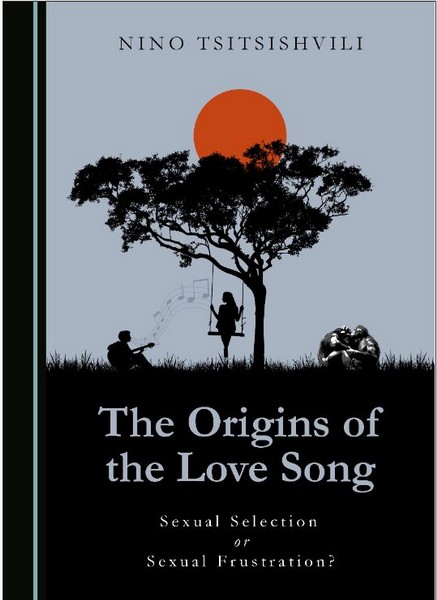
The Origins of the Love Song: Sexual Selection or Sexual Frustration?.Cambridge Scholars Publishing. Editor's pageThe book offers a radically new perspective on the origins of the love song and human sexuality in an evolutionary context. By comparing different human societies and animal species, past and present, it reveals that love songs, romantic love and exclusive pair-bonds are not the original evolutionary features of Homo sapiens. One of the key findings of the book is that early humans practiced multiple-partner sexual relations, similar to our closest relatives bonobos and chimpanzees, but, with the emergence of culture and sexual taboo, their behaviour had to adjust. It contends that, since the exodus from Africa and the rise of culture, humans started to distance themselves from the rest of the animal kingdom, drastically restraining their innate sexual nature. The book will appeal to both scholars and laypeople with an interest in evolutionary theory, socio-biology, anthropology, and the origins of culture.ISBN: 1-5275-9069-0. ISBN13: 978-1-5275-9069-4
“Sexual Taboo and Love Song in Understanding Human Evolution.” Chapter in: Friedmann, Jonathan L. (Ed.), Music in Human Experience: Perspectives on a Musical Species, Cambridge Scholars Publishing. pp. 119-138. 2022A historical examination of the links between Georgian polyphony and central Asian-transcaucasian monophony.
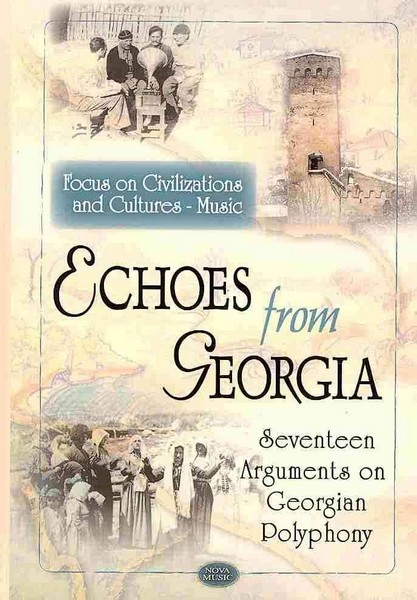
Echoes from Georgia: Seventeen Arguments on Georgian Polyphony. Rusudan Tsurtsumia and Joseph Jordania (Eds.), pp. 195-214. 2010. New York: Nova Science Publishers Inc.
The International Research Center for Traditional Polyphony of Tbilisi State Conservatoire published an English language collection of ethnomusicological works “Echoes from Georgia: Seventeen Arguments on Georgian Polyphony” in 2010. the project was realized with the support of Nova Science Publishers (USA), with the participation of Mr. Frank Columbus (President of the Publishing House) and Mrs. Nadya Gotsiridze – Columbus (Vice President), for this Georgian ethnomusicologists are grateful to them.
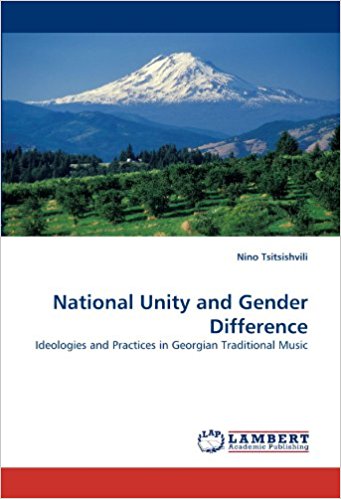
National Unity and Gender Difference in Georgian Singing.
Lambert Academic Publishing. 2010. Nino Tsitsishvili.
How gender differences are evolved, sustained and embedded in social and political structures
and how they vary across cultures and times are long-term questions of the humanities, social, cognitive and biological sciences. The book examines traditional polyphonic song performances as a marker of national identity and unity in Georgia, Caucasus. However, dominant gender ideologies and power relationships have shaped the different ways in which women and men have traditionally approached singing. While individual women have practically challenged patriarchy and redefined gender roles in Georgian music and society, symbolically, at the level of value system, men are still seen as central to Georgian traditional polyphony. The book sheds light on the ways in which gender differences are ?performed? (to use Judith Butler's concept) and should be especially useful for gender and feminist scholars, ethnomusicologists, students of Georgian and Caucasus cultures, and anyone interested in related topics. The book includes listening examples of song performances.
LAP LAMBERT Academic Publishing ISBN-10: 3838341287 / ISBN-13: 978-3838341286
Follow this link for details.
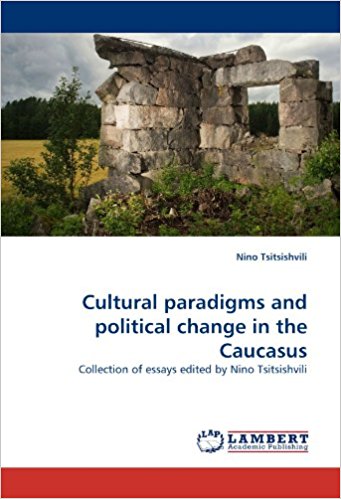
Cultural Paradigms and Political Change in the Caucasus.
Lambert Academic Publishing. 2010. Nino Tsitsishvili (editor)
Situated between Europe and Asia and affording classic example of the "clash of civilizations", the Caucasus contains socio-cultural and ethnic complexities which have often created contradictions between official political allegiances and the cultural practices of local communities. Perhaps this can explain why Christian Georgians and Muslim Chechens and Kists of the Caucasian highlands have considered each other brothers, worshipped the same deities and celebrated the same religious holidays, despite the political and religious dissent between their representative political organizations. It is too simplistic to see the Caucasus in terms of the rigid political oppositions between East and West, U.S. and Russia, Christianity and Islam, modernity and deep-rooted tradition, socialism and post-socialism. Through their exploration of cultural archetypes and political change as interrelated categories, the authors interpret the past and present of the Caucasus and envision its future, reflecting upon the prospects of building liberal democracy, free will, modernity and freedom of expression.
PAPERS
Conference PaperThe Tenth International Symposium on Traditional Polyphony, held at the International Research Centre of Traditional Polyphony at Tbilisi State Conservatory on October 20-24 October, 2020 (proceedings), eds. Rusudan Tsurtsumia and Joseph Jordania. Tbilisi State Conservatory, pp. 428-430.Conference Paper.2018-2019.


Conference Paper39th World Conference of the International-Council-for-Traditional-Music. Yearbook or Traditional Music. Vol 40. International Council for Traditional Music. (Co-authored) Adriana Helbig; Nino Tsitsishvili and Erica Haskell. pp.46-59, 2008.
Music and Politics, Vol. 3, No. 1, pp. 1-17. 2009.This article examines the effects of UNESCO’s 2001 proclamation of Georgian polyphonic song as a “masterpiece of oral and intangible heritage.” Related ideas about tradition and the safeguarding of traditional cultures are examined, as is the impact of globalization, its perceived threats and the opportunities it creates for cultural diversity, cultural exchange and dialogue.By analyzing paradoxes and contradictions arising from UNESCO’s definitions of and action plans towards “intangible cultural heritage,” the article demonstrates that the features selected by UNESCO as characteristic of “intangible heritage”—oral traditions and expressions, performing arts, social practices, and knowledge and practices concerning nature and the universe—are also found in modern Georgian popular music genres such as pop, rock, and rap, though these genres are not viewed as cultural heritage. The article thus argues that, while the long-term nationalist cultural policies endorsing the primacy of Georgian traditional polyphony have found a new ideological endorsement within UNESCO’s discourse of culture, the reality of the country’s cultural life is not accommodated.
Journal of Musicological Research, Volume 26, 2007, Issue 2-3: Music and Ideologies. pp. Pages 241-280. 2007.The study of the relationship between music and ideology in recent decades has revealed multiple expressions of national sentiment and helped us to understand those political-historical contexts in which the aesthetics of musical style are interpreted in close relation to the dominant ideologies of nation.The aesthetic perceptions of musical styles in Georgia have been influenced by monoethnic nationalism and pro-Western orientation. By supporting selected rural polyphonic singing styles of ethnic Georgians to become the symbol of national identity during the pre-communist, communist, and post-communist periods, the state's and elite's cultural discourses and policies have attenuated the status of the duduki ensembles and related urban musical styles derived from the Middle Eastern maqam/dastgah modal systems and the art of wandering ashugh/aşik minstrels
World of Music. Vol 49 (3), January. pp. 39-140, 2007.
“Funeral Chants from the Georgian Caucasus is an important ethnomusicological project and a rare video ocumentation of music and social practices in the Caucasus ... The film will also interest scholars who study the genre of lamentation as an expression of social protest, gender ideology and cultural identity, especially in wider Mediterranean scholarship.”
— Nino Tsitsishvili.You can watch here a preview of the Hugo Zemp Film.
Ethnomusicology. Vol. 50, No. 3 (Fall), pp. 452-493, 2006.This article explores aspects of gender relationships in Georgian singing, as expressed in the setting of supra, a traditional feast where participants propose toast-speeches, drink alcohol and sing polyphonic songs. Two distinct levels emerge among the multiple practices, discourses and symbolic expressions of men’s leadership and patriarchal social order at the Georgian supra feast. The first includes forms of observed behaviour and ritualised structural-formal components and rules such as the formal conduct of supra—practices of toast-speeches, constructive drinking of alcohol, performing songs and conversing in between songs and toast-speeches, in which men hold an exclusively central role.The second level includes verbal discourses as articulated in standard toasting formulas and song texts as well as implicit gender-coded demeanours expressed in the difference between men’s and women’s singing styles. The verbal discourses and demeanours of the second level contain spoken and unspoken messages about the ideals of male authority and women’s acceptance of male power, both in the physical and social domains. While the ideal gender role distribution is occasionally altered by women’s adoption of men’s formal practices and rules of proposing toasts, drinking and initiating songs (the first level), these alterations do not seem to challenge the ideology of male precedence as articulated in the standard toasting formulas, song texts and singing style that constitute the second level.
Context, Vol. 35/36 (2010/2011). pp. 39–57. 2011.A considerable portion of the general population, at least in the western world, would endorse the principle of gender equality. According to this opinion, men and women have an equal, innate potential for political action, leadership, invention, and creativity in the arts and sciences. A similar attitude is shared by scholars of the humanities, including ethnomusicologists. Differences between the sexes, and specifically men's greater share in the fields of science and artistic creativity, are controversial matters. Some believe that differences in performance between the sexes are the result of social conditioning and the patriarchal social order prevalent in most known societies; others, mostly led by evolutionary psychologists, offer an explanation based on the process of human evolution and sexual selection. The topic, one would agree, inevitably leads to a politically and scientifically charged polemic.
REVIEWS
Review: "Empire of Song: Europe and Nation in the Eurovision Song Contest". Dafni Tragaki (Ed.). Lanham, Maryland: Scarecrow Press. ISBN 9780810888173.
While the Eurovision Song Contest (ESC), Europe’s most popular musical institution and spectacle, asserts its immunity from politics, Empire of Song: Europe and Nation in the Eurovision Song Contest demonstrates that this is not the case; Eurovision involves politics and ideologies as well as constantly fluid and contested national, cultural, and gender identities. The book reveals that behind the kitsch and the sentimental and eccentric essence of Eurovision is a political institution that promotes common European awareness through culture. Eurovision and the EBU (European Broadcasting Union), reinforced by the European Union’s discourse of harmonious unification, promote hybridity and inclusiveness; but they also act as superiors, utilizing their assumed role as cultural trendsetters to incorporate the more “peripheral” countries into a collective “European” identity.
MEDIA
Audio Examples from "National Ideologies in the Era of Global Fusions: Georgian Polyphonic Song as a UNESCO-sanctioned Masterpiece of Intangible Heritage" Music and Politics - III, no. 1 (Winter 2009)